The EU Packaging Regulation 2025/40: A Turning Point for Packaging Waste

Something significant happened on 11 February 2025. The European Union's new Packaging and Packaging Waste Regulation, officially known as Regulation (EU) 2025/40 or PPWR, entered into force, replacing a directive that had been in place since 1994. From 12 August 2026, its provisions become binding across all EU Member States.
This is not a minor administrative update. It is one of the most ambitious pieces of packaging legislation ever introduced, and its effects will be felt by businesses, consumers, and the environment in equal measure. At PlasticBusters, we believe it represents a genuine cause for optimism: a signal that the systems producing so much of the plastic waste we see in our oceans, streets and parks are finally being redesigned from the ground up.
What Is the PPWR and Why Does It Matter?
For three decades, EU packaging law was governed by a directive, meaning Member States had to transpose its requirements into national law, which led to a patchwork of rules across the continent. The PPWR changes that. As a regulation, it applies directly and uniformly across all 27 EU member states without any need for national implementation. A business in Portugal faces the same requirements as one in Poland.
The regulation covers all packaging and packaging waste, regardless of material, plastic, glass, metal, paper, wood, and regardless of whether it originates from industrial, retail, or household use. Its goals are threefold: prevent unnecessary packaging, promote reuse and recycling, and contribute to the EU's circular economy and climate neutrality targets by 2050.
What Changes From August 2026?
All Packaging Must Be Recyclable
One of the regulation's headline commitments is that all packaging placed on the EU market must be recyclable by 2030. But the journey starts now. From August 2026, packaging must be designed with recyclability in mind, companies can no longer design packaging that is technically impossible or economically unviable to recycle and simply pass the environmental cost on to waste systems and taxpayers.
Packaging Must Be Right-Sized
From August 2026, empty space in packaging must not exceed 40% of the total package volume, unless technically unavoidable. This targets a practice that consumers have long found frustrating, oversized boxes, excessive void fill, and packaging clearly designed to look more impressive than it needs to be. Less packaging means less waste, lower transport emissions, and lower costs for everyone.
Hazardous Substances Banned
PFAS, per- and polyfluoroalkyl substances, sometimes called "forever chemicals", are banned from food-contact packaging from August 2026. These chemicals, widely used to make packaging grease-resistant, are persistent in the environment and increasingly linked to health risks. Their removal from the food chain is long overdue.
Extended Producer Responsibility
Producers, manufacturers, importers and distributors all face new and strengthened obligations. The principle is straightforward: if you put packaging on the market, you are responsible for what happens to it. Extended producer responsibility schemes require companies to fund the collection, sorting and recycling of the packaging they produce, shifting the cost away from municipalities and taxpayers.
What Comes Next: The 2027–2040 Timeline
The PPWR is deliberately phased, recognising that systemic change takes time. Several major provisions come into force after 2026.
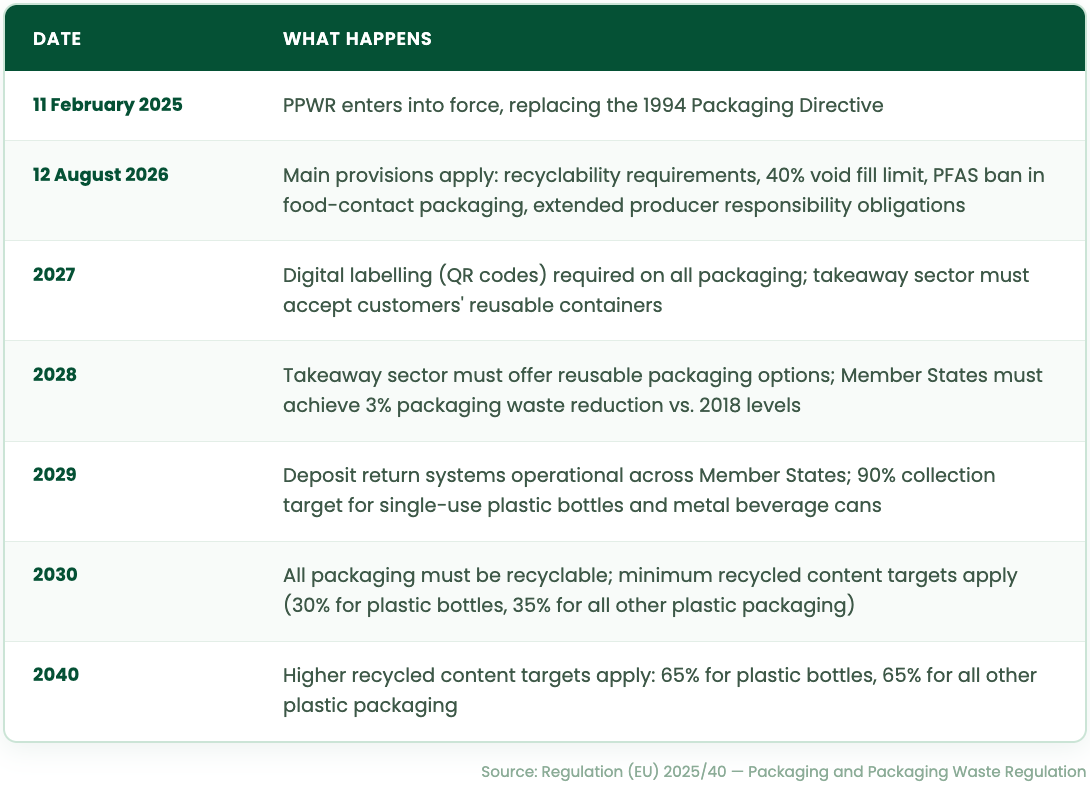
By 2027: Packaging must carry digital identifiers, such as QR codes, linking to structured environmental information including material composition, recyclability instructions, and reuse details. Businesses in the takeaway and food service sector must also give customers the option to bring their own containers.
By 2028: Takeaway operators must offer products in reusable packaging. Member States must have met a packaging waste reduction target of 3% compared to 2018 levels.
By 2029: Member States must operate deposit and return systems (DRS) for single-use plastic bottles and metal beverage containers, collecting at least 90% of these items.
By 2030: All packaging must be recyclable. Plastic packaging must meet minimum recycled content thresholds: 30% for single-use plastic bottles, 35% for all other plastic packaging, with higher targets applying by 2040.
What This Means for Businesses
If your business places packaging on the EU market, whether you are a manufacturer, importer, distributor or online platform, the PPWR affects you. The key questions to ask now are:
Is our packaging recyclable? If not, what needs to change in our design process?
Are we complying with the 40% void fill limit?
Does any of our food-contact packaging contain PFAS?
Are we registered under an extended producer responsibility scheme?
Are we prepared for digital labelling requirements from 2027?
The good news is that companies acting now, rather than waiting until the August 2026 deadline, will be better placed to absorb the changes, avoid last-minute compliance costs, and communicate their progress to increasingly sustainability-conscious customers.
It is also worth noting that the European Commission is exploring further simplifications through its Environmental Omnibus initiative, which may reduce some reporting burdens. However, the core requirements of the PPWR are expected to remain in place. Businesses should plan on the basis that the August 2026 date stands.
What This Means for Consumers
The PPWR will change what packaging looks like on shop shelves, and for the better. Expect to see less excessive packaging, clearer recycling labels, more reusable options in cafés and restaurants, and deposit return schemes making it easier to return bottles and cans.
As consumers, the most powerful thing you can do is reward businesses that are ahead of the curve. Choose products with minimal, recyclable packaging. Use deposit return schemes when they arrive. And when businesses fall short, say so, your voice matters more than you might think.
A Moment of Real Momentum
At PlasticBusters, we strongly promote individual action, and we firmly believe that every piece of litter picked up, every single-use plastic refused, every place adopted makes a difference. But we also know that individual action alone cannot solve a problem built into industrial systems. The PPWR is a sign that those systems are beginning to change.
It is not perfect. There are exemptions. There will be lobbying for delays. Implementation will be uneven. But the direction of travel is clear, and that matters enormously.
The packaging of the future will be designed to last, to be reused, to be recycled, not to be used once and discarded into the environment. That is the future we are working towards at PlasticBusters, and the PPWR is a meaningful step in that direction.
Key Dates at a Glance
The regulation is a step in the right direction, but it needs all of us to play our part. While businesses adapt their packaging, individuals and organisations can take action today.
Adopt a place you love. Join over thousands of volunteers in 100+ countries who are keeping their local streets, beaches, parks and reefs litter-free through the AdoptTheWorld initiative. Choose your place, clean it at least quarterly, and become part of a global movement.
Take the Zero Waste Pledge. Commit to doing your best to Rethink, Refuse, Reduce, Reuse, Repurpose, Recycle and Rot in your daily life or business. Join over 1,000 individuals, businesses and organisations who have already made that commitment at plasticbusters.org/pledge.
Together, regulation and individual action can make the difference our planet needs.
For more resources on reducing packaging waste, visit our Resources section.
PlasticBusters: an award-wining registered charity with over 5,000 volunteers in more than 100 countries. Would you like to volunteer with us? Please visit our Get Involved site.